





RBI
Company Details
Linkedin ID:
restaurant-brands-international
Website:
Employees number:
8,688
Number of followers:
193,624
NAICS:
722
Industry Type:
Homepage:
rbi.com
IP Addresses:
0
Company ID:
RES_2754323
Scan Status:
In-progress
Restaurant Brands International Company CyberSecurity Posture
rbi.com


Restaurant Brands International Inc. is one of the world's largest quick service restaurant companies with nearly $45 billion in annual system-wide sales and over 32,000 restaurants in more than 120 countries and territories. RBI owns four of the world's most prominent and iconic quick service restaurant brands – TIM HORTONS®, BURGER KING®, POPEYES®, and FIREHOUSE SUBS®. These independently operated brands have been serving their respective guests, franchisees and communities for decades. Through its Restaurant Brands for Good framework, RBI is improving sustainable outcomes related to its food, the planet, and people and communities.
Company Details
restaurant-brands-international
8,688
193,624
722
rbi.com
0
RES_2754323
In-progress
 RBI Risk Score (AI oriented)
Between 750 and 799
 RBI Global Score (TPRM)
XXXX
Description: Ethical hackers **BobDaHacker** and **BobTheShoplifter** exposed severe security vulnerabilities within **Restaurant Brands International (RBI)**, the parent company of Burger King, Tim Hortons, and Popeyes. The flaws included **hard-coded passwords** (e.g., 'admin') in HTML and drive-through systems, **plain-text passwords sent via email**, and an **unrestricted API** allowing unauthorized admin access. The hackers gained entry to **employee accounts, internal configurations, raw audio recordings of drive-through conversations** (containing customer personal data processed by AI), and even **restaurant bathroom rating systems**. The breaches revealed **catastrophic oversight** in cybersecurity fundamentals, with no basic safeguards like antivirus checks or system audits. While the ethical hackers responsibly disclosed the issues and confirmed **no customer data was retained**, the exposure demonstrated how easily malicious actors could have exploited these gaps. RBI reportedly fixed the vulnerabilities post-disclosure but did not publicly acknowledge the researchers, raising concerns about long-term security improvements. The incident underscores systemic negligence in protecting **30,000+ global outlets** from potential data leaks, financial fraud, or operational disruptions.


Restaurant Brands International has 40.85% more incidents than the average of same-industry companies with at least one recorded incident.
Restaurant Brands International has 29.87% more incidents than the average of all companies with at least one recorded incident.
Restaurant Brands International reported 1 incidents this year: 0 cyber attacks, 0 ransomware, 0 vulnerabilities, 1 data breaches, compared to industry peers with at least 1 incident.
RBI cyber incidents detection timeline including parent company and subsidiaries

Restaurant Brands International Inc. is one of the world's largest quick service restaurant companies with nearly $45 billion in annual system-wide sales and over 32,000 restaurants in more than 120 countries and territories. RBI owns four of the world's most prominent and iconic quick service restaurant brands – TIM HORTONS®, BURGER KING®, POPEYES®, and FIREHOUSE SUBS®. These independently operated brands have been serving their respective guests, franchisees and communities for decades. Through its Restaurant Brands for Good framework, RBI is improving sustainable outcomes related to its food, the planet, and people and communities.


Atlanta-based GoTo Foods (formerly known as Focus Brands) is a leading developer of global multi-channel foodservice brands. As of December 31, 2023, GoTo Foods, through its affiliate brands, is the franchisor and operator of more than 6,700 restaurants, cafes, ice cream shoppes, and bakeries in all

US Foods is one of America’s great food companies and a leading foodservice distributor, partnering with approximately 300,000 restaurants and foodservice operators to help their businesses succeed. With 28,000 associates and more than 70 locations, US Foods provides its customers with a broad and
We believe every consumer should have access to their favorite snack, everywhere. We own the manufacturing process from seed to shelf and actively invest in technology to automate key steps of the process. This helps us be more agile in what we need to make, who we need to make it for, and how we ca
Here at the DQ® system, we believe that HAPPY TASTES GOOD®. Our first location opened in Joliet, Illinois, 80 years ago. Since then we’ve grown to more than 7,000 DQ® locations in the U.S., Canada and 22 other countries. Our restaurants offer a variety of sweet treats and crave-worthy eats that

Greene King is the country’s leading pub company and brewer with c.2,600 pubs, restaurants and hotels across England, Wales and Scotland. At Greene King we are passionate about delivering our purpose to ‘pour happiness into lives’. That’s for our customers, our team, our pub partners, our suppliers

Coffee is at the heart of everything we do, and consumer satisfaction is why we do it. Our story started with one simple idea: everyone should be able to make the perfect cup of coffee at home. Something we still believe today, which is why we think delivering the highest quality coffee, sip after
JDE Peet’s is the world’s leading pure-play coffee company, serving approximately 4,400 cups of coffee per second in more than 100 markets. Guided by our ‘Reignite the Amazing’ strategy, we are focusing on brand-led growth across three big bets: Peet’s, L’OR, and Jacobs, alongside a collection of 9
We are one of the leading global producers and exporters of quality food, as we believe it is fundamental to a better life for all people. Not only what we do, but the way we do it, is guided by the purpose of a better life for everyone, from farm to fork. That is why we conduct a sustainable mana

Red Bull Gives Wiiings to People and Ideas. This has driven us – and all we do – since 1987. Today, Red Bull operates in over 170 countries, selling more than 12 billion cans annually and growing! Above all, our people remain the essential ingredient in bringing the Red Bull brand to life. Check out
.png)
Restaurant Brands International Inc. (NYSE: QSR) (TSX: QSR) (TSX: QSP) ("RBI") announced today that Josh Kobza, Chief Executive Officer,...
Earlier in November 2025, Restaurant Brands International announced a joint venture with Chinese asset manager CPE to grow Burger King's...
Restaurant Brands International (NYSE:QSR) is making a major move in China, teaming up with CPE to triple the number of Burger King outlets...
Restaurant Brands International Limited Partnership (TSX:QSP.UN) shares have edged higher recently, climbing nearly 2% over the past month...
Restaurant Brands International Inc. ("RBI" or the "Company") (TSX: OSR) (NYSE: QSR) announced today that an underwritten registered public...
Restaurant Brands International Inc. ("RBI" or the "Company") (TSX: QSR) (NYSE: QSR) announced today that Restaurant Brands International...
Over the next decade, the joint venture aims to more than double Burger King's footprint in China.
Restaurant Brands International said on Monday Chinese firm CPE will invest about $350 million in Burger King China as part of a joint...
What are the early trends we should look for to identify a stock that could multiply in value over the long term...

Explore insights on cybersecurity incidents, risk posture, and Rankiteo's assessments.
The official website of Restaurant Brands International is http://www.rbi.com.
According to Rankiteo, Restaurant Brands International’s AI-generated cybersecurity score is 764, reflecting their Fair security posture.
According to Rankiteo, Restaurant Brands International currently holds 0 security badges, indicating that no recognized compliance certifications are currently verified for the organization.
According to Rankiteo, Restaurant Brands International is not certified under SOC 2 Type 1.
According to Rankiteo, Restaurant Brands International does not hold a SOC 2 Type 2 certification.
According to Rankiteo, Restaurant Brands International is not listed as GDPR compliant.
According to Rankiteo, Restaurant Brands International does not currently maintain PCI DSS compliance.
According to Rankiteo, Restaurant Brands International is not compliant with HIPAA regulations.
According to Rankiteo,Restaurant Brands International is not certified under ISO 27001, indicating the absence of a formally recognized information security management framework.
Restaurant Brands International operates primarily in the Food and Beverage Services industry.
Restaurant Brands International employs approximately 8,688 people worldwide.
Restaurant Brands International presently has no subsidiaries across any sectors.
Restaurant Brands International’s official LinkedIn profile has approximately 193,624 followers.
Restaurant Brands International is classified under the NAICS code 722, which corresponds to Food Services and Drinking Places.
Yes, Restaurant Brands International has an official profile on Crunchbase, which can be accessed here: https://www.crunchbase.com/organization/restaurant-brands-international.
Yes, Restaurant Brands International maintains an official LinkedIn profile, which is actively utilized for branding and talent engagement, which can be accessed here: https://www.linkedin.com/company/restaurant-brands-international.
As of December 11, 2025, Rankiteo reports that Restaurant Brands International has experienced 1 cybersecurity incidents.
Restaurant Brands International has an estimated 8,495 peer or competitor companies worldwide.
Incident Types: The types of cybersecurity incidents that have occurred include Breach.
Detection and Response: The company detects and responds to cybersecurity incidents through an incident response plan activated with yes (after ethical hacker disclosure), and containment measures with patch applied to vulnerabilities (reportedly), and communication strategy with no public acknowledgment of ethical hackers or incident details..
Title: Hard-coded passwords exposed Burger King’s fragile security infrastructure worldwide
Description: Hackers accessed employee accounts and internal configurations with shocking ease due to weak security practices at Restaurant Brands International (RBI), the parent company of Burger King, Tim Hortons, and Popeyes. Ethical hackers BobDaHacker and BobTheShoplifter discovered hard-coded passwords (e.g., 'admin'), plain-text passwords sent via email, and unsecured APIs that allowed unrestricted access. The vulnerabilities exposed internal systems, employee accounts, drive-through audio recordings (containing customer PII), and even restaurant bathroom rating screens. The hackers described RBI’s security as 'catastrophic,' highlighting systemic neglect of basic cybersecurity fundamentals. RBI reportedly fixed the issues after disclosure but did not publicly acknowledge the ethical hackers.
Type: Unauthorized Access
Attack Vector: Hard-coded CredentialsPlain-text Passwords in EmailsUnrestricted API AccessDefault/Weak Passwords (e.g., 'admin')
Vulnerability Exploited: Hard-coded passwords in HTML/APIsLack of password encryptionMissing access controlsPoor credential management
Threat Actor: BobDaHacker (Ethical Hacker)BobTheShoplifter (Ethical Hacker)
Motivation: Ethical Hacking / Responsible Disclosure
Common Attack Types: The most common types of attacks the company has faced is Breach.
Identification of Attack Vectors: The company identifies the attack vectors used in incidents through Hard-coded password in HTMLDefault 'admin' password in drive-through tabletsUnrestricted API signup.

Data Compromised: Employee account credentials, Internal system configurations, Drive-through audio recordings (potential pii), Restaurant operational data (e.g., bathroom rating screens)
Systems Affected: Equipment ordering websiteDrive-through tablet systemsAI-powered customer/staff evaluation systemsRestaurant management APIsBathroom rating screens
Operational Impact: High (potential for unauthorized access to critical systems, customer data exposure, and operational disruption)
Brand Reputation Impact: High (public exposure of systemic security failures across global brands: Burger King, Tim Hortons, Popeyes)
Identity Theft Risk: Moderate (drive-through audio recordings may contain customer PII)
Commonly Compromised Data Types: The types of data most commonly compromised in incidents are Employee Credentials, Internal Configurations, Audio Recordings (Potential Pii), Operational Data and .
Entity Name: Restaurant Brands International (RBI)
Entity Type: Parent Company
Industry: Fast Food / Hospitality
Location: Global (30,000+ outlets)
Size: Large Enterprise
Entity Name: Burger King
Entity Type: Subsidiary
Industry: Fast Food
Location: Global
Entity Name: Tim Hortons
Entity Type: Subsidiary
Industry: Fast Food / Coffee
Location: Primarily Canada/US
Entity Name: Popeyes
Entity Type: Subsidiary
Industry: Fast Food
Location: Global
Incident Response Plan Activated: Yes (after ethical hacker disclosure)
Containment Measures: Patch applied to vulnerabilities (reportedly)
Communication Strategy: No public acknowledgment of ethical hackers or incident details
Incident Response Plan: The company's incident response plan is described as Yes (after ethical hacker disclosure).
Type of Data Compromised: Employee credentials, Internal configurations, Audio recordings (potential pii), Operational data
Sensitivity of Data: Moderate to High (includes PII in audio recordings and system access credentials)
Data Exfiltration: No (ethical hackers did not retain data)
Data Encryption: No (passwords stored in plain-text)
Personally Identifiable Information: Potential (in drive-through audio recordings)
Handling of PII Incidents: The company handles incidents involving personally identifiable information (PII) through by patch applied to vulnerabilities (reportedly) and .
Lessons Learned: Systemic neglect of basic cybersecurity practices (e.g., hard-coded passwords, plain-text credentials, unrestricted APIs) can expose global enterprises to severe risks. Ethical hacking revealed critical gaps in access controls, credential management, and operational security across RBI’s brands.
Recommendations: Implement robust password policies and multi-factor authentication (MFA), Eliminate hard-coded credentials and enforce encryption for sensitive data, Conduct regular security audits and penetration testing, Restrict API access with proper authentication/authorization, Establish a transparent vulnerability disclosure program, Train employees on secure credential handling and phishing risks, Monitor dark web for exposed credentials or system accessImplement robust password policies and multi-factor authentication (MFA), Eliminate hard-coded credentials and enforce encryption for sensitive data, Conduct regular security audits and penetration testing, Restrict API access with proper authentication/authorization, Establish a transparent vulnerability disclosure program, Train employees on secure credential handling and phishing risks, Monitor dark web for exposed credentials or system accessImplement robust password policies and multi-factor authentication (MFA), Eliminate hard-coded credentials and enforce encryption for sensitive data, Conduct regular security audits and penetration testing, Restrict API access with proper authentication/authorization, Establish a transparent vulnerability disclosure program, Train employees on secure credential handling and phishing risks, Monitor dark web for exposed credentials or system accessImplement robust password policies and multi-factor authentication (MFA), Eliminate hard-coded credentials and enforce encryption for sensitive data, Conduct regular security audits and penetration testing, Restrict API access with proper authentication/authorization, Establish a transparent vulnerability disclosure program, Train employees on secure credential handling and phishing risks, Monitor dark web for exposed credentials or system accessImplement robust password policies and multi-factor authentication (MFA), Eliminate hard-coded credentials and enforce encryption for sensitive data, Conduct regular security audits and penetration testing, Restrict API access with proper authentication/authorization, Establish a transparent vulnerability disclosure program, Train employees on secure credential handling and phishing risks, Monitor dark web for exposed credentials or system accessImplement robust password policies and multi-factor authentication (MFA), Eliminate hard-coded credentials and enforce encryption for sensitive data, Conduct regular security audits and penetration testing, Restrict API access with proper authentication/authorization, Establish a transparent vulnerability disclosure program, Train employees on secure credential handling and phishing risks, Monitor dark web for exposed credentials or system accessImplement robust password policies and multi-factor authentication (MFA), Eliminate hard-coded credentials and enforce encryption for sensitive data, Conduct regular security audits and penetration testing, Restrict API access with proper authentication/authorization, Establish a transparent vulnerability disclosure program, Train employees on secure credential handling and phishing risks, Monitor dark web for exposed credentials or system access
Key Lessons Learned: The key lessons learned from past incidents are Systemic neglect of basic cybersecurity practices (e.g., hard-coded passwords, plain-text credentials, unrestricted APIs) can expose global enterprises to severe risks. Ethical hacking revealed critical gaps in access controls, credential management, and operational security across RBI’s brands.
Source: Tom’s Hardware
Source: Ethical Hackers’ Blog (Archived)
Additional Resources: Stakeholders can find additional resources on cybersecurity best practices at and Source: Tom’s Hardware, and Source: Ethical Hackers’ Blog (Archived).
Investigation Status: Completed (by ethical hackers; RBI applied fixes but no public report)
Communication of Investigation Status: The company communicates the status of incident investigations to stakeholders through No public acknowledgment of ethical hackers or incident details.
Entry Point: Hard-Coded Password In Html, Default 'Admin' Password In Drive-Through Tablets, Unrestricted Api Signup,
High Value Targets: Employee Accounts, Internal Configurations, Drive-Through Audio Systems, Restaurant Management Apis,
Data Sold on Dark Web: Employee Accounts, Internal Configurations, Drive-Through Audio Systems, Restaurant Management Apis,
Root Causes: Lack Of Basic Cybersecurity Hygiene (E.G., Hard-Coded Passwords, Plain-Text Credentials), Absence Of Access Controls (E.G., Unrestricted Api Access), Inadequate System Audits And Vulnerability Assessments, Poor Credential Management Practices, Corporate Neglect Of Security Fundamentals Despite Global Scale,
Corrective Actions: Patches Applied To Reported Vulnerabilities (Per Rbi), No Public Confirmation Of Broader Security Overhaul Or Policy Changes,
Corrective Actions Taken: The company has taken the following corrective actions based on post-incident analysis: Patches Applied To Reported Vulnerabilities (Per Rbi), No Public Confirmation Of Broader Security Overhaul Or Policy Changes, .
Last Attacking Group: The attacking group in the last incident was an BobDaHacker (Ethical Hacker)BobTheShoplifter (Ethical Hacker).
Most Significant Data Compromised: The most significant data compromised in an incident were Employee account credentials, Internal system configurations, Drive-through audio recordings (potential PII), Restaurant operational data (e.g., bathroom rating screens) and .
Most Significant System Affected: The most significant system affected in an incident was Equipment ordering websiteDrive-through tablet systemsAI-powered customer/staff evaluation systemsRestaurant management APIsBathroom rating screens.
Containment Measures in Most Recent Incident: The containment measures taken in the most recent incident was Patch applied to vulnerabilities (reportedly).
Most Sensitive Data Compromised: The most sensitive data compromised in a breach were Internal system configurations, Employee account credentials, Restaurant operational data (e.g., bathroom rating screens) and Drive-through audio recordings (potential PII).
Most Significant Lesson Learned: The most significant lesson learned from past incidents was Systemic neglect of basic cybersecurity practices (e.g., hard-coded passwords, plain-text credentials, unrestricted APIs) can expose global enterprises to severe risks. Ethical hacking revealed critical gaps in access controls, credential management, and operational security across RBI’s brands.
Most Significant Recommendation Implemented: The most significant recommendation implemented to improve cybersecurity was Monitor dark web for exposed credentials or system access, Restrict API access with proper authentication/authorization, Conduct regular security audits and penetration testing, Implement robust password policies and multi-factor authentication (MFA), Train employees on secure credential handling and phishing risks, Establish a transparent vulnerability disclosure program and Eliminate hard-coded credentials and enforce encryption for sensitive data.
Most Recent Source: The most recent source of information about an incident are Ethical Hackers’ Blog (Archived) and Tom’s Hardware.
Current Status of Most Recent Investigation: The current status of the most recent investigation is Completed (by ethical hackers; RBI applied fixes but no public report).
.png)
FreePBX Endpoint Manager is a module for managing telephony endpoints in FreePBX systems. Versions prior to 16.0.96 and 17.0.1 through 17.0.9 have a weak default password. By default, this is a 6 digit numeric value which can be brute forced. (This is the app_password parameter). Depending on local configuration, this password could be the extension, voicemail, user manager, DPMA or EPM phone admin password. This issue is fixed in versions 16.0.96 and 17.0.10.
Neuron is a PHP framework for creating and orchestrating AI Agents. In versions 2.8.11 and below, the MySQLWriteTool executes arbitrary SQL provided by the caller using PDO::prepare() + execute() without semantic restrictions. This is consistent with the name (“write tool”), but in an LLM/agent context it becomes a high-risk capability: prompt injection or indirect prompt manipulation can cause execution of destructive queries such as DROP TABLE, TRUNCATE, DELETE, ALTER, or privilege-related statements (subject to DB permissions). Deployments that expose an agent with MySQLWriteTool enabled to untrusted input and/or run the tool with a DB user that has broad privileges are impacted. This issue is fixed in version 2.8.12.
Neuron is a PHP framework for creating and orchestrating AI Agents. Versions 2.8.11 and below use MySQLSelectTool, which is vulnerable to Read-Only Bypass. MySQLSelectTool is intended to be a read-only SQL tool (e.g., for LLM agent querying, however, validation based on the first keyword (e.g., SELECT) and a forbidden-keyword list does not block file-writing constructs such as INTO OUTFILE / INTO DUMPFILE. As a result, an attacker who can influence the tool input (e.g., via prompt injection through a public agent endpoint) may write arbitrary files to the DB server if the MySQL/MariaDB account has the FILE privilege and server configuration permits writes to a useful location (e.g., a web-accessible directory). This issue is fixed in version 2.8.12.
Okta Java Management SDK facilitates interactions with the Okta management API. In versions 11.0.0 through 20.0.0, race conditions may arise from concurrent requests using the ApiClient class. This could cause a status code or response header from one request’s response to influence another request’s response. This issue is fixed in version 20.0.1.
The Auth0 Next.js SDK is a library for implementing user authentication in Next.js applications. When using versions 4.11.0 through 4.11.2 and 4.12.0, simultaneous requests on the same client may result in improper lookups in the TokenRequestCache for the request results. This issue is fixed in versions 4.11.2 and 4.12.1.

Get company history

Every week, Rankiteo analyzes billions of signals to give organizations a sharper, faster view of emerging risks. With deeper, more actionable intelligence at their fingertips, security teams can outpace threat actors, respond instantly to Zero-Day attacks, and dramatically shrink their risk exposure window.
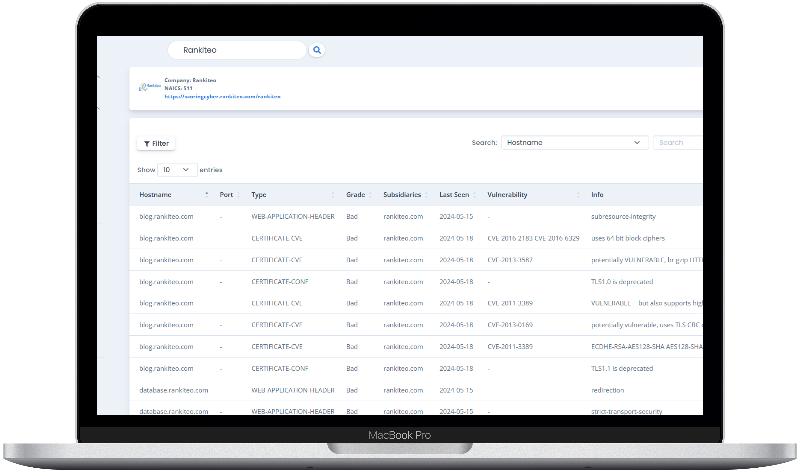
Identify exposed access points, detect misconfigured SSL certificates, and uncover vulnerabilities across the network infrastructure.
Gain visibility into the software components used within an organization to detect vulnerabilities, manage risk, and ensure supply chain security.
Monitor and manage all IT assets and their configurations to ensure accurate, real-time visibility across the company's technology environment.
Leverage real-time insights on active threats, malware campaigns, and emerging vulnerabilities to proactively defend against evolving cyberattacks.







 Rapid
Rapid