





PPDVS
Company Details
Linkedin ID:
petroleosdevenezuela
Website:
Employees number:
25,485
Number of followers:
125,635
NAICS:
211
Industry Type:
Homepage:
https://www.pdvsa.com
IP Addresses:
0
Company ID:
PDV_3245789
Scan Status:
In-progress

PDVSA Petróleos de Venezuela S.A. Company CyberSecurity Posture
https://www.pdvsa.com


Petróleos de Venezuela S.A. is a Venezuelan state company, began operations on January 1st, 1976 and whose activities are the oil exploration, production, refining, marketing and transportation of Venezuelan oil as well as the orimulsion, chemical, petrochemical businesses and coal. We have the largest oil reserves in the world, reaching at the end of 2013, a total certified sum of 298,353 million barrels, which represent 20% of the world reserves of this resource. Also we manage 197.1 trillion cubic feet of natural gas in proven reserves, a figure that places us in eighth place worldwide. PDVSA carries out its crude processing operations through 14 refineries: six in Venezuela, and nine in the rest of the world. The national refining system is made up of 6 refineries that have a processing capacity of 1 million 303 MBD of which 52% is destined for the local market and 48% for export. The international refining system is made up of 9 refineries located in the Caribbean region, United States and Europe. Our subsidiaries and affiliates are located across the globe in Venezuela, Belgium, China, Dominican Republic, Netherlands, Sweden, the United Kingdom and the United States. Headquartered in Caracas, Venezuela, with offices and operations throughout the country, we employ more than 140,000 workers worldwide.
Company Details
petroleosdevenezuela
25,485
125,635
211
https://www.pdvsa.com
0
PDV_3245789
In-progress
 PPDVS Risk Score (AI oriented)
Between 750 and 799
 PPDVS Global Score (TPRM)
XXXX
Description: In December 2002, during a general strike in Venezuela, a port facility operated by **PDVSA** (Venezuela’s state-owned oil company) was targeted in a deliberate cyber attack. The attacker, likely an insider (possibly an employee involved in the strike), remotely accessed the **SCADA (Supervisory Control and Data Acquisition) system** controlling the port’s operations. The attacker **erased all PLC (Programmable Logic Controller) programs**, crippling the facility’s ability to load oil tankers. The sabotage lasted **eight hours**, causing Venezuela’s national oil production to plummet from **3 million barrels per day (BPD) to just 300,000 BPD**—a **90% reduction**.The attack directly disrupted Venezuela’s oil-dependent economy, which relied heavily on exports. The temporary shutdown of the port facility contributed to broader economic instability during the strike, exacerbating fuel shortages and financial losses. While no physical damage or loss of life occurred, the **targeted disruption of critical infrastructure**—a key sector for the nation’s revenue—demonstrated the vulnerability of industrial control systems to cyber sabotage. The incident highlighted how cyber attacks on energy infrastructure could be weaponized for **political or economic coercion**, with cascading effects on national production and global oil markets.


No incidents recorded for PDVSA Petróleos de Venezuela S.A. in 2025.
No incidents recorded for PDVSA Petróleos de Venezuela S.A. in 2025.
No incidents recorded for PDVSA Petróleos de Venezuela S.A. in 2025.
PPDVS cyber incidents detection timeline including parent company and subsidiaries
Petróleos de Venezuela S.A. is a Venezuelan state company, began operations on January 1st, 1976 and whose activities are the oil exploration, production, refining, marketing and transportation of Venezuelan oil as well as the orimulsion, chemical, petrochemical businesses and coal. We have the largest oil reserves in the world, reaching at the end of 2013, a total certified sum of 298,353 million barrels, which represent 20% of the world reserves of this resource. Also we manage 197.1 trillion cubic feet of natural gas in proven reserves, a figure that places us in eighth place worldwide. PDVSA carries out its crude processing operations through 14 refineries: six in Venezuela, and nine in the rest of the world. The national refining system is made up of 6 refineries that have a processing capacity of 1 million 303 MBD of which 52% is destined for the local market and 48% for export. The international refining system is made up of 9 refineries located in the Caribbean region, United States and Europe. Our subsidiaries and affiliates are located across the globe in Venezuela, Belgium, China, Dominican Republic, Netherlands, Sweden, the United Kingdom and the United States. Headquartered in Caracas, Venezuela, with offices and operations throughout the country, we employ more than 140,000 workers worldwide.

We are a global oil and gas company tasked with an important job—to safely find and deliver energy for the world. We’re experts in what we do—from the well site to the office. Across our operations and activities in 13 countries, we never forget our responsibility to be a great neighbor, and a gre

We’re a leading producer of the energy and chemicals that drive global commerce and enhance the daily lives of people around the globe by continuing delivering an uninterrupted supply of energy to the world. Our resilience and agility has built one of the world’s largest integrated energy and chemi
Nosso propósito é prover energia que assegure prosperidade de forma ética, justa, segura e competitiva. Queremos ser a melhor empresa diversificada e integrada de energia na geração de valor, construindo um mundo mais sustentável, conciliando o foco em óleo e gás com a diversificação em negócios de

Besmindo Group is a leader in providing new tool joints; repair & redress of tool joints, pup joints, drill pipes, threads for tool joints and OCTG tubing. The mission is to continually provide these and other services by promoting a reputation for excellence and value while fully anticipating, then
PT Pertamina (Persero) is an Indonesian state-owned enterprise, which is engaged in the integrated energy in Indonesia. Established on December 10, 1957, Pertamina had the experiences in upstream, midstream, downstream and renewable energy sectors for more than 50 years. This is the official Link
At Repsol, we are at the forefront of the energy sector to build the future of energy with innovation and sustainability. We are a strong multienergy company that creates value in an integrated, diversified, and sustainable way to promote progress in society. We leverage our past experience to be pr

Tenaris is a leading supplier of tubes and related services for the world’s energy industry and certain other industrial applications. Our mission is to deliver value to our customers through product development, manufacturing excellence, and supply chain management. Tenaris employees around the wor

We're Equinor, an international energy company with a proud history. Formerly Statoil, we are 20,000 committed colleagues developing oil, gas, wind and solar energy in more than 30 countries worldwide. We’re the largest operator in Norway, among the world’s largest offshore operators, and a growing
ОАО Oil and Gas Company «RussNeft» came into existence in September 2002 . The structure of OAO NK “RussNeft” counts 24 upstream enterprises, 2 refineries, its own distribution net of gas filling stations. Geographic reach of “RussNeft” covers 12 regions of Russia and CIS: Khanty-Mansi Autonomous
.png)
Venezuela's state-owned oil company is asking the D.C. Circuit to revisit its ruling from last month ordering the company to face...
Venezuela's state-owned oil company plans to appeal a New York federal judge's recent decision ordering it to pay $2.86 billion to...
A New York judge who last month confirmed the validity of defaulted Venezuelan bonds ruled on Friday that Venezuela's state oil firm PDVSA...
Venezuela's President Nicolas Maduro has appointed a new supply and trade vice president at state oil company PDVSA, according to a decree...
Venezuelan state-run PDVSA's oil sales abroad in 2024 stood at $17.52 billion, according to a results document seen by Reuters on Friday, as exports jumped.
Holders of a key bond defaulted by Venezuela's state oil company PDVSA asked a New York judge on Thursday to ensure they can claim...
The Trump administration on Monday wound down a license allowing shipments of liquefied petroleum gas (LPG) to Venezuela's state energy...
Venezuela's state oil company PDVSA has canceled several authorizations it had granted U.S.-based producer Chevron to load and export...
Venezuelan state-run oil firm PDVSA will cut office hours for its administrative workers, an internal document seen by Reuters showed,...

Explore insights on cybersecurity incidents, risk posture, and Rankiteo's assessments.
The official website of PDVSA Petróleos de Venezuela S.A. is https://www.pdvsa.com.
According to Rankiteo, PDVSA Petróleos de Venezuela S.A.’s AI-generated cybersecurity score is 772, reflecting their Fair security posture.
According to Rankiteo, PDVSA Petróleos de Venezuela S.A. currently holds 0 security badges, indicating that no recognized compliance certifications are currently verified for the organization.
According to Rankiteo, PDVSA Petróleos de Venezuela S.A. is not certified under SOC 2 Type 1.
According to Rankiteo, PDVSA Petróleos de Venezuela S.A. does not hold a SOC 2 Type 2 certification.
According to Rankiteo, PDVSA Petróleos de Venezuela S.A. is not listed as GDPR compliant.
According to Rankiteo, PDVSA Petróleos de Venezuela S.A. does not currently maintain PCI DSS compliance.
According to Rankiteo, PDVSA Petróleos de Venezuela S.A. is not compliant with HIPAA regulations.
According to Rankiteo,PDVSA Petróleos de Venezuela S.A. is not certified under ISO 27001, indicating the absence of a formally recognized information security management framework.
PDVSA Petróleos de Venezuela S.A. operates primarily in the Oil and Gas industry.
PDVSA Petróleos de Venezuela S.A. employs approximately 25,485 people worldwide.
PDVSA Petróleos de Venezuela S.A. presently has no subsidiaries across any sectors.
PDVSA Petróleos de Venezuela S.A.’s official LinkedIn profile has approximately 125,635 followers.
PDVSA Petróleos de Venezuela S.A. is classified under the NAICS code 211, which corresponds to Oil and Gas Extraction.
No, PDVSA Petróleos de Venezuela S.A. does not have a profile on Crunchbase.
Yes, PDVSA Petróleos de Venezuela S.A. maintains an official LinkedIn profile, which is actively utilized for branding and talent engagement, which can be accessed here: https://www.linkedin.com/company/petroleosdevenezuela.
As of December 11, 2025, Rankiteo reports that PDVSA Petróleos de Venezuela S.A. has experienced 1 cybersecurity incidents.
PDVSA Petróleos de Venezuela S.A. has an estimated 10,531 peer or competitor companies worldwide.
Incident Types: The types of cybersecurity incidents that have occurred include Cyber Attack.
Detection and Response: The company detects and responds to cybersecurity incidents through an remediation measures with restoration of erased plc programs, and recovery measures with resumed tanker loading after 8 hours..
Title: 2002 Venezuela Port Facility SCADA Hack During General Strike
Description: In December 2002, during the general strike in Venezuela, a port facility's SCADA system was hacked by someone (possibly an employee involved in the strike). The attacker remotely accessed the system to erase all PLC (Programmable Logic Controller) programs, halting tanker loading operations for eight hours. This caused Venezuela's national oil production to plummet from 3 million barrels per day (BPD) to 300,000 BPD.
Date Detected: 2002-12
Type: cyber-physical attack
Attack Vector: insider threat (possible)remote access
Vulnerability Exploited: weak SCADA system securityunauthorized remote access
Threat Actor: possibly an employee involved in the general strikeunknown external actor (unconfirmed)
Motivation: political (supporting the general strike)economic sabotage (disrupting oil production)
Common Attack Types: The most common types of attacks the company has faced is Cyber Attack.
Identification of Attack Vectors: The company identifies the attack vectors used in incidents through remote access to SCADA system.

Data Compromised: PLC programs (erased)
Systems Affected: SCADA systemProgrammable Logic Controllers (PLCs)
Downtime: 8 hours (tanker loading operations halted)
Operational Impact: port facility operations disruptedoil production dropped from 3M BPD to 300K BPD
Commonly Compromised Data Types: The types of data most commonly compromised in incidents are Plc Programs (Operational Data) and .
Entity Name: Unnamed Venezuela Port Facility (oil production hub)
Entity Type: government-owned/operated port
Industry: oil and gas
Location: Venezuela
Remediation Measures: restoration of erased PLC programs
Recovery Measures: resumed tanker loading after 8 hours
Type of Data Compromised: Plc programs (operational data)
Sensitivity of Data: high (critical infrastructure control systems)
Data Exfiltration: no (data was erased, not stolen)
File Types Exposed: PLC configuration files
Prevention of Data Exfiltration: The company takes the following measures to prevent data exfiltration: restoration of erased PLC programs, .
Data Recovery from Ransomware: The company recovers data encrypted by ransomware through resumed tanker loading after 8 hours, .
Investigation Status: historical (limited public details)
Entry Point: Remote Access To Scada System,
High Value Targets: Plc Programs Controlling Tanker Loading,
Data Sold on Dark Web: Plc Programs Controlling Tanker Loading,
Root Causes: Inadequate Scada Security, Lack Of Access Controls, Insider Threat Risk,
Last Attacking Group: The attacking group in the last incident was an possibly an employee involved in the general strikeunknown external actor (unconfirmed).
Most Recent Incident Detected: The most recent incident detected was on 2002-12.
Most Significant Data Compromised: The most significant data compromised in an incident was PLC programs (erased).
Most Significant System Affected: The most significant system affected in an incident was SCADA systemProgrammable Logic Controllers (PLCs).
Most Sensitive Data Compromised: The most sensitive data compromised in a breach was PLC programs (erased).
Current Status of Most Recent Investigation: The current status of the most recent investigation is historical (limited public details).
.png)
FreePBX Endpoint Manager is a module for managing telephony endpoints in FreePBX systems. Versions prior to 16.0.96 and 17.0.1 through 17.0.9 have a weak default password. By default, this is a 6 digit numeric value which can be brute forced. (This is the app_password parameter). Depending on local configuration, this password could be the extension, voicemail, user manager, DPMA or EPM phone admin password. This issue is fixed in versions 16.0.96 and 17.0.10.
Neuron is a PHP framework for creating and orchestrating AI Agents. In versions 2.8.11 and below, the MySQLWriteTool executes arbitrary SQL provided by the caller using PDO::prepare() + execute() without semantic restrictions. This is consistent with the name (“write tool”), but in an LLM/agent context it becomes a high-risk capability: prompt injection or indirect prompt manipulation can cause execution of destructive queries such as DROP TABLE, TRUNCATE, DELETE, ALTER, or privilege-related statements (subject to DB permissions). Deployments that expose an agent with MySQLWriteTool enabled to untrusted input and/or run the tool with a DB user that has broad privileges are impacted. This issue is fixed in version 2.8.12.
Neuron is a PHP framework for creating and orchestrating AI Agents. Versions 2.8.11 and below use MySQLSelectTool, which is vulnerable to Read-Only Bypass. MySQLSelectTool is intended to be a read-only SQL tool (e.g., for LLM agent querying, however, validation based on the first keyword (e.g., SELECT) and a forbidden-keyword list does not block file-writing constructs such as INTO OUTFILE / INTO DUMPFILE. As a result, an attacker who can influence the tool input (e.g., via prompt injection through a public agent endpoint) may write arbitrary files to the DB server if the MySQL/MariaDB account has the FILE privilege and server configuration permits writes to a useful location (e.g., a web-accessible directory). This issue is fixed in version 2.8.12.
Okta Java Management SDK facilitates interactions with the Okta management API. In versions 11.0.0 through 20.0.0, race conditions may arise from concurrent requests using the ApiClient class. This could cause a status code or response header from one request’s response to influence another request’s response. This issue is fixed in version 20.0.1.
The Auth0 Next.js SDK is a library for implementing user authentication in Next.js applications. When using versions 4.11.0 through 4.11.2 and 4.12.0, simultaneous requests on the same client may result in improper lookups in the TokenRequestCache for the request results. This issue is fixed in versions 4.11.2 and 4.12.1.

Get company history

Every week, Rankiteo analyzes billions of signals to give organizations a sharper, faster view of emerging risks. With deeper, more actionable intelligence at their fingertips, security teams can outpace threat actors, respond instantly to Zero-Day attacks, and dramatically shrink their risk exposure window.
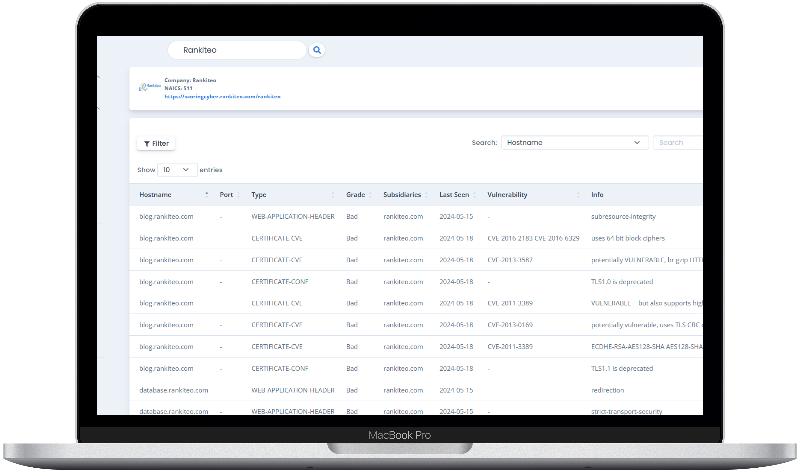
Identify exposed access points, detect misconfigured SSL certificates, and uncover vulnerabilities across the network infrastructure.
Gain visibility into the software components used within an organization to detect vulnerabilities, manage risk, and ensure supply chain security.
Monitor and manage all IT assets and their configurations to ensure accurate, real-time visibility across the company's technology environment.
Leverage real-time insights on active threats, malware campaigns, and emerging vulnerabilities to proactively defend against evolving cyberattacks.







 Rapid
Rapid