





NFCU
Company Details
Linkedin ID:
navy-federal-credit-union
Website:
Employees number:
23,853
Number of followers:
164,441
NAICS:
52
Industry Type:
Homepage:
navyfederal.org
IP Addresses:
0
Company ID:
NAV_1378981
Scan Status:
In-progress

Navy Federal Credit Union Company CyberSecurity Posture
navyfederal.org


Navy Federal is the world’s largest credit union, with more than 14 million members, $180 billion+ in assets and 24,000+ employees. Throughout campuses in Vienna, VA Pensacola, FL and Winchester, VA, as well as more than 360 branches, we serve the Armed Forces, Department of Defense, Veterans and their families with world-class financial products and services. Navy Federal provides much more than a job. We provide a meaningful career experience, including a culture that is energized, engaged and committed; and fierce appreciation for our teams, who are rewarded with highly competitive pay and generous benefits and perks. Our approach to careers is simple yet powerful: Make our mission your passion. Federally insured by NCUA. Equal opportunity employer. Android™ is a trademark of Google, Inc. iPhone® is a registered trademark of Apple, Inc. iPad® is a registered trademark of Apple, Inc. App Store(SM) is a service mark of Apple, Inc. Message and data rates may apply. FORTUNE and 100 Best Companies to Work For are registered trademarks of Time Inc., and are used under license. FORTUNE and Time Inc., are not affiliated with, and do not endorse products or services of, Navy Federal Credit Union. For more info, visit navyfederal.org. Images used for representational purposes only; do not imply government endorsement. Equal Housing Lender Equal Opportunity Employer, including disability/vets
Company Details
navy-federal-credit-union
23,853
164,441
52
navyfederal.org
0
NAV_1378981
In-progress
 NFCU Risk Score (AI oriented)
Between 700 and 749
 NFCU Global Score (TPRM)
XXXX
Description: Cybersecurity researcher Jeremiah Fowler discovered an unprotected 378 GB database belonging to **Navy Federal Credit Union (NFCU)**, exposed publicly without encryption or password protection. The breach revealed sensitive internal files, including operational metadata, hashed passwords, system logs, plain-text usernames/emails, and Tableau workbooks containing database connection details, financial formulas, and loan portfolio metrics. While **no direct customer data (e.g., account numbers, SSNs) was exposed in plain text**, the leaked internal details—such as employee credentials, system architectures, and business intelligence—create severe risks. Attackers could exploit this information for **phishing, credential stuffing, or supply-chain attacks**, potentially escalating access to member data or financial systems. The incident underscores systemic vulnerabilities in third-party handling of sensitive data, though NFCU secured the database after discovery. The exposure, while not immediately catastrophic, provides cybercriminals with a **roadmap for deeper intrusions**, threatening long-term operational and member security.


Navy Federal Credit Union has 21.95% more incidents than the average of same-industry companies with at least one recorded incident.
Navy Federal Credit Union has 29.87% more incidents than the average of all companies with at least one recorded incident.
Navy Federal Credit Union reported 1 incidents this year: 0 cyber attacks, 0 ransomware, 0 vulnerabilities, 1 data breaches, compared to industry peers with at least 1 incident.
NFCU cyber incidents detection timeline including parent company and subsidiaries
Navy Federal is the world’s largest credit union, with more than 14 million members, $180 billion+ in assets and 24,000+ employees. Throughout campuses in Vienna, VA Pensacola, FL and Winchester, VA, as well as more than 360 branches, we serve the Armed Forces, Department of Defense, Veterans and their families with world-class financial products and services. Navy Federal provides much more than a job. We provide a meaningful career experience, including a culture that is energized, engaged and committed; and fierce appreciation for our teams, who are rewarded with highly competitive pay and generous benefits and perks. Our approach to careers is simple yet powerful: Make our mission your passion. Federally insured by NCUA. Equal opportunity employer. Android™ is a trademark of Google, Inc. iPhone® is a registered trademark of Apple, Inc. iPad® is a registered trademark of Apple, Inc. App Store(SM) is a service mark of Apple, Inc. Message and data rates may apply. FORTUNE and 100 Best Companies to Work For are registered trademarks of Time Inc., and are used under license. FORTUNE and Time Inc., are not affiliated with, and do not endorse products or services of, Navy Federal Credit Union. For more info, visit navyfederal.org. Images used for representational purposes only; do not imply government endorsement. Equal Housing Lender Equal Opportunity Employer, including disability/vets


FactSet creates flexible, open data and software solutions for tens of thousands of investment professionals around the world, providing instant access to financial data and analytics that investors use to make crucial decisions. For 40 years, through market changes and technological progress, our

Sun Life is a leading financial services organization dedicated to helping people achieve lifetime financial security and live healthier lives. We provide a wide range of insurance and investment products and services in key markets around the world including Canada, the United States, the United K
Founded in 1914, Merrill is one of the largest wealth management businesses in the world. Merrill financial advisors combine financial knowledge and experience with a deep understanding of their clients’ needs to help their clients pursue the lives they want. With a deep commitment to placing their
We aspire to be the world’s most exceptional financial institution, united by our shared values of partnership, client service, integrity, and excellence. Operating at the center of capital markets, we act as one firm, mobilizing our people, capital, and ideas to deliver superior results across ou

From local communities to global markets, we are dedicated to shaping the future responsibly and helping clients thrive in a changing world. “Bank of America Merrill Lynch” is the marketing name for the global banking and global markets businesses of Bank of America Corporation. Bank of America is

We provide employee, financial and legal administration so that firms can invest and operate safely around the world. TMF Group is a single global team with over 11,000 colleagues in more than 125 offices across 87 jurisdictions, covering 92% of world GDP and 95% of FDI inflow. We bring common c

Founded in 1962 and a public company since 1983, Raymond James Financial, Inc. is a Florida-based diversified holding company providing financial services to individuals, corporations and municipalities through its subsidiary companies engaged primarily in investment and financial planning, in addit

Bienvenido a la página oficial del Banco BBVA Bancomer. Institución financiera de México desde 1932. Es una empresa filial de Banco Bilbao Vizcaya Argentaria (BBVA), uno de los grupos financieros líderes en Europa y considerado entre uno de los más grandes de la Zona Euro. El Grupo trabaja por un f

Principal Financial Group® is dedicated to improving the wealth and well-being of people and businesses around the world—helping more than 62M customers plan, protect, invest, and retire as of December 31, 2023. Along the way, we commit to supporting the communities where we do business. Improving o
.png)
With many federal employees heading toward a possible second missed paycheck at the end of the week — and little promise of an end to the...
Some Navy Federal CDs have competitive rates, but you'll need to meet eligibility requirements to bank with the military-focused credit...
A failure at an Amazon Web Services data center in Virginia caused widespread outages, hitting services at several banks and fintechs.
Explore the best Navy Federal Credit Union credit cards tailored to military members and their families. Find cards offering rewards and low...
Navy Federal Credit Union today announced Rear Admiral John V. Menoni, USN (Ret.) has been named its next senior vice president of Branch...
Wildboy” and “Jizzle” are in trouble with federal prosecutors after allegedly scamming 500 military members in a bank scheme.
NORFOLK, Va. — Hundreds of Navy Federal Credit Union members have been victimized in a long-running scam that cost millions of dollars,...
10 suspects arrested for targeting military personnel in a scam costing up to $2M. Navy Federal urges caution with phone security in public...
Supply chain attacks hit finance firms, a breach at Jaguar halts production and Kaseya Labs probes new Akira ransomware.

Explore insights on cybersecurity incidents, risk posture, and Rankiteo's assessments.
The official website of Navy Federal Credit Union is http://www.navyfederal.org.
According to Rankiteo, Navy Federal Credit Union’s AI-generated cybersecurity score is 726, reflecting their Moderate security posture.
According to Rankiteo, Navy Federal Credit Union currently holds 0 security badges, indicating that no recognized compliance certifications are currently verified for the organization.
According to Rankiteo, Navy Federal Credit Union is not certified under SOC 2 Type 1.
According to Rankiteo, Navy Federal Credit Union does not hold a SOC 2 Type 2 certification.
According to Rankiteo, Navy Federal Credit Union is not listed as GDPR compliant.
According to Rankiteo, Navy Federal Credit Union does not currently maintain PCI DSS compliance.
According to Rankiteo, Navy Federal Credit Union is not compliant with HIPAA regulations.
According to Rankiteo,Navy Federal Credit Union is not certified under ISO 27001, indicating the absence of a formally recognized information security management framework.
Navy Federal Credit Union operates primarily in the Financial Services industry.
Navy Federal Credit Union employs approximately 23,853 people worldwide.
Navy Federal Credit Union presently has no subsidiaries across any sectors.
Navy Federal Credit Union’s official LinkedIn profile has approximately 164,441 followers.
Navy Federal Credit Union is classified under the NAICS code 52, which corresponds to Finance and Insurance.
No, Navy Federal Credit Union does not have a profile on Crunchbase.
Yes, Navy Federal Credit Union maintains an official LinkedIn profile, which is actively utilized for branding and talent engagement, which can be accessed here: https://www.linkedin.com/company/navy-federal-credit-union.
As of December 11, 2025, Rankiteo reports that Navy Federal Credit Union has experienced 1 cybersecurity incidents.
Navy Federal Credit Union has an estimated 30,346 peer or competitor companies worldwide.
Incident Types: The types of cybersecurity incidents that have occurred include Breach.
Detection and Response: The company detects and responds to cybersecurity incidents through an containment measures with database secured post-discovery..
Title: Unprotected Database Exposure at Navy Federal Credit Union (NFCU)
Description: Cybersecurity researcher Jeremiah Fowler discovered an unprotected 378 GB database containing sensitive internal files linked to Navy Federal Credit Union (NFCU). The database was publicly accessible without encryption or password protection, exposing operational metadata, hashed passwords, internal usernames, emails, and business intelligence workbooks. While no customer data was visible in plain text, the exposed internal details could facilitate phishing, credential stuffing, or further intrusions by cybercriminals.
Type: data exposure
Attack Vector: unsecured databaselack of encryptionlack of authentication
Vulnerability Exploited: misconfigured databaseunprotected storage
Common Attack Types: The most common types of attacks the company has faced is Breach.

Data Compromised: Operational metadata, Hashed passwords, Storage locations, System logs, Internal usernames, Emails (plain text), Tableau business intelligence workbooks (database connection details, financial performance formulas, loan portfolio metrics)
Operational Impact: potential for targeted phishingcredential stuffingsocial engineering attacksfuture exploitation via operational blueprints
Brand Reputation Impact: potential erosion of trust due to exposure of sensitive internal data
Identity Theft Risk: ['increased risk due to exposed internal usernames, emails, and operational details']
Commonly Compromised Data Types: The types of data most commonly compromised in incidents are Operational Metadata, Hashed Passwords, Internal Usernames, Emails, Business Intelligence Workbooks, System Logs, Database Connection Details, Financial Performance Formulas, Loan Portfolio Metrics and .
Entity Name: Navy Federal Credit Union (NFCU)
Entity Type: financial institution
Industry: banking/credit union
Location: United States
Containment Measures: database secured post-discovery
Type of Data Compromised: Operational metadata, Hashed passwords, Internal usernames, Emails, Business intelligence workbooks, System logs, Database connection details, Financial performance formulas, Loan portfolio metrics
Sensitivity of Data: high (internal operational and financial details)
Data Encryption: ['no (database was unencrypted)']
File Types Exposed: .gz.sql.twbx
Personally Identifiable Information: internal usernamesemails
Handling of PII Incidents: The company handles incidents involving personally identifiable information (PII) through by database secured post-discovery and .
Lessons Learned: The incident underscores the critical importance of securing databases with encryption and authentication, even for internal or operational data. Exposure of non-customer data (e.g., internal usernames, system logs, business intelligence) can still enable targeted attacks like phishing or credential stuffing, posing significant downstream risks to both the organization and its members.
Recommendations: Implement robust encryption and access controls for all databases, including those containing operational or internal data., Regularly audit third-party vendors and contractors for security vulnerabilities to mitigate supply chain risks., Monitor for exposed credentials or internal details on the Dark Web to preemptively address potential threats., Educate employees and members on recognizing phishing and social engineering attempts, especially following data exposures., Adopt tools like Bitdefender Digital Identity Protection to proactively detect and respond to identity-related risks.Implement robust encryption and access controls for all databases, including those containing operational or internal data., Regularly audit third-party vendors and contractors for security vulnerabilities to mitigate supply chain risks., Monitor for exposed credentials or internal details on the Dark Web to preemptively address potential threats., Educate employees and members on recognizing phishing and social engineering attempts, especially following data exposures., Adopt tools like Bitdefender Digital Identity Protection to proactively detect and respond to identity-related risks.Implement robust encryption and access controls for all databases, including those containing operational or internal data., Regularly audit third-party vendors and contractors for security vulnerabilities to mitigate supply chain risks., Monitor for exposed credentials or internal details on the Dark Web to preemptively address potential threats., Educate employees and members on recognizing phishing and social engineering attempts, especially following data exposures., Adopt tools like Bitdefender Digital Identity Protection to proactively detect and respond to identity-related risks.Implement robust encryption and access controls for all databases, including those containing operational or internal data., Regularly audit third-party vendors and contractors for security vulnerabilities to mitigate supply chain risks., Monitor for exposed credentials or internal details on the Dark Web to preemptively address potential threats., Educate employees and members on recognizing phishing and social engineering attempts, especially following data exposures., Adopt tools like Bitdefender Digital Identity Protection to proactively detect and respond to identity-related risks.Implement robust encryption and access controls for all databases, including those containing operational or internal data., Regularly audit third-party vendors and contractors for security vulnerabilities to mitigate supply chain risks., Monitor for exposed credentials or internal details on the Dark Web to preemptively address potential threats., Educate employees and members on recognizing phishing and social engineering attempts, especially following data exposures., Adopt tools like Bitdefender Digital Identity Protection to proactively detect and respond to identity-related risks.
Key Lessons Learned: The key lessons learned from past incidents are The incident underscores the critical importance of securing databases with encryption and authentication, even for internal or operational data. Exposure of non-customer data (e.g., internal usernames, system logs, business intelligence) can still enable targeted attacks like phishing or credential stuffing, posing significant downstream risks to both the organization and its members.
Source: Jeremiah Fowler (Cybersecurity Researcher)
Additional Resources: Stakeholders can find additional resources on cybersecurity best practices at and Source: Jeremiah Fowler (Cybersecurity Researcher).
Investigation Status: Resolved (database secured post-discovery)
Customer Advisories: Consumers advised to use identity protection tools (e.g., Bitdefender Digital Identity Protection) and monitor for phishing or credential stuffing attempts.
Advisories Provided: The company provides the following advisories to stakeholders and customers following an incident: were Consumers Advised To Use Identity Protection Tools (E.G., Bitdefender Digital Identity Protection) And Monitor For Phishing Or Credential Stuffing Attempts. and .
Root Causes: Unprotected Database Lacking Encryption And Authentication, Potential Third-Party Mishandling Of Sensitive Data,
Most Significant Data Compromised: The most significant data compromised in an incident were operational metadata, hashed passwords, storage locations, system logs, internal usernames, emails (plain text), Tableau business intelligence workbooks (database connection details, financial performance formulas, loan portfolio metrics) and .
Containment Measures in Most Recent Incident: The containment measures taken in the most recent incident was database secured post-discovery.
Most Sensitive Data Compromised: The most sensitive data compromised in a breach were system logs, Tableau business intelligence workbooks (database connection details, financial performance formulas, loan portfolio metrics), operational metadata, emails (plain text), internal usernames, hashed passwords and storage locations.
Most Significant Lesson Learned: The most significant lesson learned from past incidents was The incident underscores the critical importance of securing databases with encryption and authentication, even for internal or operational data. Exposure of non-customer data (e.g., internal usernames, system logs, business intelligence) can still enable targeted attacks like phishing or credential stuffing, posing significant downstream risks to both the organization and its members.
Most Significant Recommendation Implemented: The most significant recommendation implemented to improve cybersecurity was Implement robust encryption and access controls for all databases, including those containing operational or internal data., Regularly audit third-party vendors and contractors for security vulnerabilities to mitigate supply chain risks., Monitor for exposed credentials or internal details on the Dark Web to preemptively address potential threats., Educate employees and members on recognizing phishing and social engineering attempts, especially following data exposures. and Adopt tools like Bitdefender Digital Identity Protection to proactively detect and respond to identity-related risks..
Most Recent Source: The most recent source of information about an incident is Jeremiah Fowler (Cybersecurity Researcher).
Current Status of Most Recent Investigation: The current status of the most recent investigation is Resolved (database secured post-discovery).
Most Recent Customer Advisory: The most recent customer advisory issued were an Consumers advised to use identity protection tools (e.g. and Bitdefender Digital Identity Protection) and monitor for phishing or credential stuffing attempts.
.png)
FreePBX Endpoint Manager is a module for managing telephony endpoints in FreePBX systems. Versions prior to 16.0.96 and 17.0.1 through 17.0.9 have a weak default password. By default, this is a 6 digit numeric value which can be brute forced. (This is the app_password parameter). Depending on local configuration, this password could be the extension, voicemail, user manager, DPMA or EPM phone admin password. This issue is fixed in versions 16.0.96 and 17.0.10.
Neuron is a PHP framework for creating and orchestrating AI Agents. In versions 2.8.11 and below, the MySQLWriteTool executes arbitrary SQL provided by the caller using PDO::prepare() + execute() without semantic restrictions. This is consistent with the name (“write tool”), but in an LLM/agent context it becomes a high-risk capability: prompt injection or indirect prompt manipulation can cause execution of destructive queries such as DROP TABLE, TRUNCATE, DELETE, ALTER, or privilege-related statements (subject to DB permissions). Deployments that expose an agent with MySQLWriteTool enabled to untrusted input and/or run the tool with a DB user that has broad privileges are impacted. This issue is fixed in version 2.8.12.
Neuron is a PHP framework for creating and orchestrating AI Agents. Versions 2.8.11 and below use MySQLSelectTool, which is vulnerable to Read-Only Bypass. MySQLSelectTool is intended to be a read-only SQL tool (e.g., for LLM agent querying, however, validation based on the first keyword (e.g., SELECT) and a forbidden-keyword list does not block file-writing constructs such as INTO OUTFILE / INTO DUMPFILE. As a result, an attacker who can influence the tool input (e.g., via prompt injection through a public agent endpoint) may write arbitrary files to the DB server if the MySQL/MariaDB account has the FILE privilege and server configuration permits writes to a useful location (e.g., a web-accessible directory). This issue is fixed in version 2.8.12.
Okta Java Management SDK facilitates interactions with the Okta management API. In versions 11.0.0 through 20.0.0, race conditions may arise from concurrent requests using the ApiClient class. This could cause a status code or response header from one request’s response to influence another request’s response. This issue is fixed in version 20.0.1.
The Auth0 Next.js SDK is a library for implementing user authentication in Next.js applications. When using versions 4.11.0 through 4.11.2 and 4.12.0, simultaneous requests on the same client may result in improper lookups in the TokenRequestCache for the request results. This issue is fixed in versions 4.11.2 and 4.12.1.

Get company history

Every week, Rankiteo analyzes billions of signals to give organizations a sharper, faster view of emerging risks. With deeper, more actionable intelligence at their fingertips, security teams can outpace threat actors, respond instantly to Zero-Day attacks, and dramatically shrink their risk exposure window.
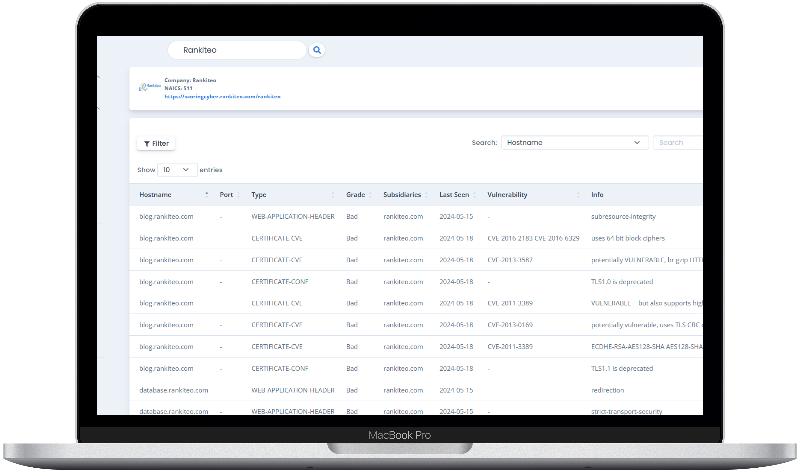
Identify exposed access points, detect misconfigured SSL certificates, and uncover vulnerabilities across the network infrastructure.
Gain visibility into the software components used within an organization to detect vulnerabilities, manage risk, and ensure supply chain security.
Monitor and manage all IT assets and their configurations to ensure accurate, real-time visibility across the company's technology environment.
Leverage real-time insights on active threats, malware campaigns, and emerging vulnerabilities to proactively defend against evolving cyberattacks.





 Rapid
Rapid