





DBS Bank
Company Details
Linkedin ID:
dbs-bank
Website:
Employees number:
33,276
Number of followers:
1,063,313
NAICS:
52211
Industry Type:
Homepage:
dbs.com
IP Addresses:
0
Company ID:
DBS_2911825
Scan Status:
In-progress

DBS Bank Company CyberSecurity Posture
dbs.com


DBS is a leading financial services group in Asia with a presence in 19 markets. Headquartered and listed in Singapore, DBS is in the three key Asian axes of growth: Greater China, Southeast Asia and South Asia. The bank's "AA-" and "Aa1" credit ratings are among the highest in the world. Recognised for its global leadership, DBS has been named “World’s Best Bank” by Global Finance, “World’s Best Bank” by Euromoney and “Global Bank of the Year” by The Banker. The bank is at the forefront of leveraging digital technology to shape the future of banking, having been named “World’s Best Digital Bank” by Euromoney and the world’s “Most Innovative in Digital Banking” by The Banker. In addition, DBS has been accorded the “Safest Bank in Asia“ award by Global Finance for 14 consecutive years from 2009 to 2022. DBS provides a full range of services in consumer, SME and corporate banking. As a bank born and bred in Asia, DBS understands the intricacies of doing business in the region’s most dynamic markets. DBS is committed to building lasting relationships with customers, as it banks the Asian way. Through the DBS Foundation, the bank creates impact beyond banking by supporting social enterprises: businesses with a double bottom-line of profit and social and/or environmental impact. DBS Foundation also gives back to society in various ways, including equipping communities with future-ready skills and building food resilience. With its extensive network of operations in Asia and emphasis on engaging and empowering its staff, DBS presents exciting career opportunities. For more information, please visit www.dbs.com
Company Details
dbs-bank
33,276
1,063,313
52211
dbs.com
0
DBS_2911825
In-progress
 DBS Bank Risk Score (AI oriented)
Between 750 and 799
 DBS Bank Global Score (TPRM)
XXXX
Description: DBS Bank, a leading financial institution in Singapore, fell victim to a **ghost-tapping** cyberattack targeting its customers' payment cards linked to mobile wallets like **Apple Pay**. Between **October and December 2024**, cybercriminals—primarily Chinese-speaking threat actors—exploited **NFC relay techniques** to conduct **in-person retail fraud** using stolen card credentials. The attack involved **automated systems** to harvest and add compromised DBS Bank cards to mobile wallets at **4-8 minute intervals**, bypassing authentication measures. A total of **656 incidents** were reported, with **502 cases** specifically tied to Apple Pay, resulting in **financial losses exceeding $1.2 million SGD**. The **ghost-tapping ecosystem** leveraged **burner phones**, **NFCGate tools**, and a **criminal supply chain** spanning **Cambodia and China**, enabling real-time relay of tokenized payment data to money mules at retail terminals. The attack exploited **legitimate NFC protocols**, circumventing multi-factor authentication and time-limited security features. While no **large-scale data breach** of DBS’s core systems was confirmed, the incident exposed vulnerabilities in **contactless payment security**, leading to **direct financial fraud** against customers and reputational risks for the bank due to **media coverage** of the sophisticated attack method.


No incidents recorded for DBS Bank in 2025.
No incidents recorded for DBS Bank in 2025.
No incidents recorded for DBS Bank in 2025.
DBS Bank cyber incidents detection timeline including parent company and subsidiaries

DBS is a leading financial services group in Asia with a presence in 19 markets. Headquartered and listed in Singapore, DBS is in the three key Asian axes of growth: Greater China, Southeast Asia and South Asia. The bank's "AA-" and "Aa1" credit ratings are among the highest in the world. Recognised for its global leadership, DBS has been named “World’s Best Bank” by Global Finance, “World’s Best Bank” by Euromoney and “Global Bank of the Year” by The Banker. The bank is at the forefront of leveraging digital technology to shape the future of banking, having been named “World’s Best Digital Bank” by Euromoney and the world’s “Most Innovative in Digital Banking” by The Banker. In addition, DBS has been accorded the “Safest Bank in Asia“ award by Global Finance for 14 consecutive years from 2009 to 2022. DBS provides a full range of services in consumer, SME and corporate banking. As a bank born and bred in Asia, DBS understands the intricacies of doing business in the region’s most dynamic markets. DBS is committed to building lasting relationships with customers, as it banks the Asian way. Through the DBS Foundation, the bank creates impact beyond banking by supporting social enterprises: businesses with a double bottom-line of profit and social and/or environmental impact. DBS Foundation also gives back to society in various ways, including equipping communities with future-ready skills and building food resilience. With its extensive network of operations in Asia and emphasis on engaging and empowering its staff, DBS presents exciting career opportunities. For more information, please visit www.dbs.com


Welcome to the official LinkedIn page of Central Bank of India. Central Bank of India offers a wide range of products and services for every segment. Please join us to know more about our best products & services, attractive offers and the latest updates. We invite & value your active participatio

Depuis son rapprochement avec le Groupe Crédit Agricole SA en 2003, le périmètre d'activités de LCL, réseau national de banque de détail, est axé sur le marché des particuliers, des professionnels, des entreprises et la Banque privée. LCL est une banque de proximité qui compte 2 065 implantations

Equitas Small Finance Bank is an active member of the communities where we live and work, and a strong philanthropic partner enabling individuals, families, businesses, and entire communities in their financial aspirations with seamless banking services. We take the responsibility to be good neighbo

Established in 1907, today, we are a family of over 141 million customers and 40000 staff members. With a 100% CBS network of 6000+ branches and 5400+ ATMs and BNAs, Indian Bank has a wide national footprint, besides foreign branches in Singapore and Colombo, along with arrangements with 640 Oversea

We’re here to do Right By You. At UOB, we aspire to build a better future for the people and businesses in the region. Through our extensive network and suite of capabilities, we offer financial solutions to the people and businesses within, and connecting with ASEAN. We create solutions tail
Eu experimentei um novo jeito de me comunicar com você. Você usa o mundo digital para criar um universo totalmente seu e nesse novo universo eu acompanho você. Eu sei… Você é muito mais que digital. Eu olho para você e me vejo. Este é um dos motivos de eu estar aqui para conversar com você. Eu s
Credit Suisse Group AG has been acquired by UBS Group AG. UBS is the world’s largest and only truly global wealth manager. We operate through four business divisions: Global Wealth Management, Personal & Corporate Banking, Asset Management, and the Investment Bank. Our global reach and the breadth

We are the leading financial group in the Spanish market, comprised of banking business, insurance activity and investments in international banks and leading companies in the services sector. CaixaBank is a financial group with a socially responsible, long-term universal banking model, based on qua
Somos una Corporación líder y comprometida con el país que brinda servicios financieros de excelencia a cada segmento de clientes. Buscamos permanentemente ser el mejor Banco para ellos, ser el mejor lugar para trabajar y ser la mejor inversión para nuestros accionistas. Lo hacemos de forma colabora
.png)
As corporate scams grow more sophisticated, and scammers masterfully exploit the human psyche and thrive on uneven defences, multi-layered...
Hong Kong, 29 Jun 2025 - In response to a sharp increase in cyber threats targeting local businesses, DBS Bank (Hong Kong) Limited (“DBS Hong Kong”) today...
Cybercriminals are increasingly using artificial intelligence (AI) to create convincing and hard-to-detect attacks.
Many FIs host labs nurturing outside startups. These labs operate around the world and focus on everything from deploying Gen AI to...
MAS and CSA are studying the possibility of requiring vendors to obtain these certifications before they can be licensed or bid for government contracts.
Customer data from DBS and Bank of China's Singapore branch (BOC) were stolen when their printing vendor was hit by a ransomware attack last week.
A ransomware attack on a printing vendor has affected DBS and Bank of China – two major banks in Asia. Thousands of customers are exposed.
Toppan Next Tech, a printing vendor for several financial institutions in Singapore, suffered a ransomware attack that compromised information associated with...
The recent cyber incident involving DBS and Bank of China Singapore, where customer data has been reportedly extracted after a ransomware attack on a printing...

Explore insights on cybersecurity incidents, risk posture, and Rankiteo's assessments.
The official website of DBS Bank is https://www.dbs.com/default.page.
According to Rankiteo, DBS Bank’s AI-generated cybersecurity score is 788, reflecting their Fair security posture.
According to Rankiteo, DBS Bank currently holds 0 security badges, indicating that no recognized compliance certifications are currently verified for the organization.
According to Rankiteo, DBS Bank is not certified under SOC 2 Type 1.
According to Rankiteo, DBS Bank does not hold a SOC 2 Type 2 certification.
According to Rankiteo, DBS Bank is not listed as GDPR compliant.
According to Rankiteo, DBS Bank does not currently maintain PCI DSS compliance.
According to Rankiteo, DBS Bank is not compliant with HIPAA regulations.
According to Rankiteo,DBS Bank is not certified under ISO 27001, indicating the absence of a formally recognized information security management framework.
DBS Bank operates primarily in the Banking industry.
DBS Bank employs approximately 33,276 people worldwide.
DBS Bank presently has no subsidiaries across any sectors.
DBS Bank’s official LinkedIn profile has approximately 1,063,313 followers.
DBS Bank is classified under the NAICS code 52211, which corresponds to Commercial Banking.
No, DBS Bank does not have a profile on Crunchbase.
Yes, DBS Bank maintains an official LinkedIn profile, which is actively utilized for branding and talent engagement, which can be accessed here: https://www.linkedin.com/company/dbs-bank.
As of December 11, 2025, Rankiteo reports that DBS Bank has experienced 1 cybersecurity incidents.
DBS Bank has an estimated 6,989 peer or competitor companies worldwide.
Incident Types: The types of cybersecurity incidents that have occurred include Cyber Attack.
Total Financial Loss: The total financial loss from these incidents is estimated to be $1.20 million.
Detection and Response: The company detects and responds to cybersecurity incidents through an incident response plan activated with likely (by dbs bank, apple, google), and third party assistance with recorded future (threat intelligence), third party assistance with singapore authorities (investigation), third party assistance with cybersecurity firms (forensic analysis), and law enforcement notified with singapore police force (656 cases reported), law enforcement notified with potential interpol coordination (cross-border crime), and containment measures with enhanced mfa for mobile wallet onboarding, containment measures with transaction velocity limits, containment measures with geofencing for suspicious nfc transactions, and remediation measures with patch nfc protocol vulnerabilities, remediation measures with customer notification & card reissuance, remediation measures with phishing awareness campaigns, and recovery measures with fraudulent transaction reversals, recovery measures with compensation for affected users, recovery measures with collaboration with retailers to flag mule activity, and communication strategy with public advisories (singapore authorities), communication strategy with customer alerts (apple/google/dbs), communication strategy with media statements on mitigation efforts, and enhanced monitoring with nfc transaction anomaly detection, enhanced monitoring with dark web monitoring for stolen credentials, enhanced monitoring with telegram channel surveillance (e.g., @webu8)..
Title: Ghost-Tapping Cyber Fraud Campaign Targeting Mobile Wallet Payment Systems (Apple Pay, Google Pay)
Description: A sophisticated cybercriminal technique called 'ghost-tapping' emerged as a significant threat to contactless payment systems, exploiting stolen payment card details linked to mobile wallet services like Apple Pay and Google Pay. The attack leverages NFC relay tactics to facilitate retail fraud, transforming digital theft into physical goods via an elaborate network of mules and automated systems. The campaign spans multiple countries, primarily orchestrated by Chinese-speaking threat actors, and involves a convergence of phishing, NFC relay technology, and a criminal supply chain for burner phones and stolen credentials. Between October–December 2024, 656 compromised mobile wallet cases were reported in Singapore, with 502 specifically targeting Apple Pay, resulting in losses exceeding $1.2 million SGD.
Date Detected: 2024-10-01
Date Publicly Disclosed: 2024-12-31
Type: Financial Fraud
Attack Vector: Phishing (Credential Harvesting)Mobile MalwareNFC Relay (via NFCGate)Automated Card Addition to Mobile WalletsBurner Phone Supply ChainMoney Mule Networks
Vulnerability Exploited: Weak Authentication in Mobile Wallet OnboardingNFC Protocol Abuse (Legitimate Traffic Relay)Bypass of Time-Limited MFA WindowsLack of Geofencing for Transaction ValidationExploitable Gaps in Contactless Payment Tokenization
Threat Actor: Name: @webu8 (Telegram Handle), Affiliation: Chinese-Speaking Cybercriminal Syndicate, Role: Supplier of Burner Phones, Ghost-Tapping Services, and Stolen Credentials, Location: ['Cambodia', 'China'], Language: Chinese, Tools Used: ['NFCGate (Repurposed Android App)', 'Automated Card Addition Scripts', 'Telegram for Criminal Coordination'], Name: Unnamed Criminal Syndicates, Affiliation: Southeast Asian Cybercrime Networks, Role: ['Phishing Operators', 'Money Mules', 'Logistics Coordinators', 'Dark Web Data Brokers'], Location: ['Cambodia', 'China', 'Singapore (Targeted)', 'Global (Victims)'], Language: Chinese, Tools Used: ['Custom NFC Relay Servers', 'Automated Phishing Kits', 'Mobile Malware (Credential Theft)'].
Motivation: Financial GainExploitation of Payment System WeaknessesScalable Fraud OperationsResale of Stolen Goods (Luxury Items)
Common Attack Types: The most common types of attacks the company has faced is Cyber Attack.
Identification of Attack Vectors: The company identifies the attack vectors used in incidents through Phishing Emails/SMS (Credential Harvesting)Mobile Malware (e.g. and Fake Banking Apps)Dark Web Data Dumps (Previously Breached Cards).

Financial Loss: $1.2 million SGD (Singapore alone, Q4 2024)
Data Compromised: Payment card credentials (656 cases in singapore), Mobile wallet tokens (apple pay: 502 cases), Personally identifiable information (via phishing/malware)
Systems Affected: Apple PayGoogle PayDBS Bank Card SystemsRetail POS Terminals (NFC-Enabled)Mobile Wallet Authentication Servers
Operational Impact: Increased Fraud Detection Costs for BanksDisruption to Contactless Payment TrustRetailer Chargeback BurdenRegulatory Scrutiny on Mobile Wallet Providers
Revenue Loss: ['Direct Fraudulent Purchases (Luxury Goods)', 'Potential Decline in Mobile Wallet Adoption']
Customer Complaints: 656 reported cases (Singapore, Q4 2024)
Brand Reputation Impact: Erosion of Trust in Apple Pay/Google Pay SecurityNegative Media Coverage for Affected Banks (e.g., DBS)Consumer Skepticism Toward Contactless Payments
Legal Liabilities: Potential Lawsuits from Affected CustomersRegulatory Fines for Compliance Violations (e.g., PCI DSS)
Identity Theft Risk: High (via Phishing/Malware)
Payment Information Risk: Critical (Tokenized Card Data Relayed in Real-Time)
Average Financial Loss: The average financial loss per incident is $1.20 million.
Commonly Compromised Data Types: The types of data most commonly compromised in incidents are Payment Card Numbers, Mobile Wallet Tokens, Cvv/Cvc Codes (Via Phishing), Banking Credentials (Username/Password), Transaction Histories and .
Entity Name: Apple Inc. (Apple Pay)
Entity Type: Technology Company
Industry: Financial Technology (FinTech)
Location: Cupertino, California, USA
Size: Large (Global)
Customers Affected: 502 (Singapore, Q4 2024)
Entity Name: Google LLC (Google Pay)
Entity Type: Technology Company
Industry: Financial Technology (FinTech)
Location: Mountain View, California, USA
Size: Large (Global)
Customers Affected: Unspecified (Part of 656 total cases)
Entity Name: DBS Bank
Entity Type: Financial Institution
Industry: Banking
Location: Singapore
Size: Large (Regional)
Customers Affected: Targeted in Automated Card Addition Attacks
Entity Name: Retailers (Unspecified)
Entity Type: Business
Industry: Retail (Luxury Goods)
Location: Global (Mule Operations)
Size: Varies
Entity Name: Consumers (Mobile Wallet Users)
Entity Type: Individuals
Location: Global
Customers Affected: 656 (Reported in Singapore)
Incident Response Plan Activated: Likely (by DBS Bank, Apple, Google)
Third Party Assistance: Recorded Future (Threat Intelligence), Singapore Authorities (Investigation), Cybersecurity Firms (Forensic Analysis).
Law Enforcement Notified: Singapore Police Force (656 Cases Reported), Potential INTERPOL Coordination (Cross-Border Crime),
Containment Measures: Enhanced MFA for Mobile Wallet OnboardingTransaction Velocity LimitsGeofencing for Suspicious NFC Transactions
Remediation Measures: Patch NFC Protocol VulnerabilitiesCustomer Notification & Card ReissuancePhishing Awareness Campaigns
Recovery Measures: Fraudulent Transaction ReversalsCompensation for Affected UsersCollaboration with Retailers to Flag Mule Activity
Communication Strategy: Public Advisories (Singapore Authorities)Customer Alerts (Apple/Google/DBS)Media Statements on Mitigation Efforts
Enhanced Monitoring: NFC Transaction Anomaly DetectionDark Web Monitoring for Stolen CredentialsTelegram Channel Surveillance (e.g., @webu8)
Incident Response Plan: The company's incident response plan is described as Likely (by DBS Bank, Apple, Google).
Third-Party Assistance: The company involves third-party assistance in incident response through Recorded Future (Threat Intelligence), Singapore Authorities (Investigation), Cybersecurity Firms (Forensic Analysis), .
Type of Data Compromised: Payment card numbers, Mobile wallet tokens, Cvv/cvc codes (via phishing), Banking credentials (username/password), Transaction histories
Number of Records Exposed: 656 (Singapore, Q4 2024)
Sensitivity of Data: High (Financial + PII)
Data Exfiltration: Yes (via Phishing/Malware to Criminal Servers)
Data Encryption: Bypassed (Tokenization Exploited)
Personally Identifiable Information: Names (Linked to Cards)Email AddressesPhone NumbersPhysical Addresses (for Mule Coordination)
Prevention of Data Exfiltration: The company takes the following measures to prevent data exfiltration: Patch NFC Protocol Vulnerabilities, Customer Notification & Card Reissuance, Phishing Awareness Campaigns, .
Handling of PII Incidents: The company handles incidents involving personally identifiable information (PII) through by enhanced mfa for mobile wallet onboarding, transaction velocity limits, geofencing for suspicious nfc transactions and .
Data Recovery from Ransomware: The company recovers data encrypted by ransomware through Fraudulent Transaction Reversals, Compensation for Affected Users, Collaboration with Retailers to Flag Mule Activity, .
Regulations Violated: Payment Card Industry Data Security Standard (PCI DSS), Singapore Personal Data Protection Act (PDPA), Potential GDPR (for EU Citizens Affected),
Legal Actions: Ongoing Investigations (Singapore), Potential Charges for Money Mules,
Regulatory Notifications: Monetary Authority of Singapore (MAS)Singapore Police Force (SPF)
Ensuring Regulatory Compliance: The company ensures compliance with regulatory requirements through Ongoing Investigations (Singapore), Potential Charges for Money Mules, .
Lessons Learned: NFC Relay Attacks Exploit Legitimate Protocols, Requiring Behavioral Detection, Automated Phishing/Malware Campaigns Can Scale Rapidly with Minimal Detection, Burner Phone Supply Chains Enable Persistent Fraud Operations, Cross-Border Criminal Collaboration Complicates Law Enforcement, Mobile Wallet Authentication Needs Adaptive, Context-Aware Controls
Recommendations: For Mobile Wallet Providers (Apple/Google): Implement Device Fingerprinting for Wallet Onboarding, Enforce Geofencing for High-Risk Transactions, Deploy AI-Based Anomaly Detection for NFC Relay Patterns, Collaborate with Banks on Real-Time Fraud Alerts. For Banks (e.g., DBS): Shorten MFA Approval Windows to <2 Minutes, Block Bulk Card Addition Attempts from Single IPs/Devices, Monitor Dark Web for Compromised Credentials, Educate Customers on Phishing Risks. For Retailers: Train Staff to Identify Mule Behavior (e.g., Bulk Luxury Purchases), Implement POS Transaction Velocity Checks, Report Suspicious NFC Transactions to Payment Networks. For Law Enforcement: Target Burner Phone Supply Chains (e.g., @webu8), Disrupt Telegram-Based Criminal Marketplaces, Enhance Cross-Border Information Sharing. For Consumers: Enable Transaction Alerts for Mobile Wallets, Avoid Storing Cards in Multiple Wallets, Regularly Check for Unauthorized Devices in Wallet Apps.
Key Lessons Learned: The key lessons learned from past incidents are NFC Relay Attacks Exploit Legitimate Protocols, Requiring Behavioral Detection,Automated Phishing/Malware Campaigns Can Scale Rapidly with Minimal Detection,Burner Phone Supply Chains Enable Persistent Fraud Operations,Cross-Border Criminal Collaboration Complicates Law Enforcement,Mobile Wallet Authentication Needs Adaptive, Context-Aware Controls.
Implemented Recommendations: The company has implemented the following recommendations to improve cybersecurity: For: Banks (e.g., DBS), , For: Consumers, , For: Retailers, , For: Mobile Wallet Providers (Apple/Google), , For: Law Enforcement and .
Source: Recorded Future
URL: https://www.recordedfuture.com
Date Accessed: 2024-12-31
Source: Singapore Police Force (SPF) Advisory
URL: https://www.police.gov.sg
Date Accessed: 2024-12-30
Source: NFCGate GitHub Repository (Legitimate Tool Abused)
URL: https://github.com/NFCGate/NFCGate
Date Accessed: 2024-12-29
Source: DBS Bank Security Bulletin
URL: https://www.dbs.com
Date Accessed: 2024-12-28
Additional Resources: Stakeholders can find additional resources on cybersecurity best practices at and Source: Recorded FutureUrl: https://www.recordedfuture.comDate Accessed: 2024-12-31, and Source: Singapore Police Force (SPF) AdvisoryUrl: https://www.police.gov.sgDate Accessed: 2024-12-30, and Source: NFCGate GitHub Repository (Legitimate Tool Abused)Url: https://github.com/NFCGate/NFCGateDate Accessed: 2024-12-29, and Source: DBS Bank Security BulletinUrl: https://www.dbs.comDate Accessed: 2024-12-28.
Investigation Status: Ongoing (Singapore Authorities + Private Sector)
Communication of Investigation Status: The company communicates the status of incident investigations to stakeholders through Public Advisories (Singapore Authorities), Customer Alerts (Apple/Google/Dbs) and Media Statements On Mitigation Efforts.
Stakeholder Advisories: Singapore Monetary Authority (Mas) – Fraud Risk Warning, Apple Security Update (Ios 17.3+ Nfc Protections), Google Pay Fraud Prevention Guide.
Customer Advisories: DBS Bank: 'Beware of Ghost-Tapping Scams' (Dec 2024)Apple Support: 'Protect Your Apple Pay from Unauthorized Use'Singapore Police Force: 'Contactless Payment Fraud Alert'
Advisories Provided: The company provides the following advisories to stakeholders and customers following an incident: were Singapore Monetary Authority (Mas) – Fraud Risk Warning, Apple Security Update (Ios 17.3+ Nfc Protections), Google Pay Fraud Prevention Guide, Dbs Bank: 'Beware Of Ghost-Tapping Scams' (Dec 2024), Apple Support: 'Protect Your Apple Pay From Unauthorized Use', Singapore Police Force: 'Contactless Payment Fraud Alert' and .
Entry Point: Phishing Emails/Sms (Credential Harvesting), Mobile Malware (E.G., Fake Banking Apps), Dark Web Data Dumps (Previously Breached Cards),
Reconnaissance Period: Ongoing (Since at Least Q3 2024)
Backdoors Established: ['Persistent Access via Burner Phones', 'NFC Relay Infrastructure for Real-Time Exploitation']
High Value Targets: Apple Pay Users (502 Cases In Singapore), Dbs Bank Customers (Automated Attacks), Luxury Retailers (For Mule Purchases),
Data Sold on Dark Web: Apple Pay Users (502 Cases In Singapore), Dbs Bank Customers (Automated Attacks), Luxury Retailers (For Mule Purchases),
Root Causes: Over-Reliance On Static Authentication For Wallet Onboarding, Lack Of Nfc Transaction Context Awareness (E.G., Geolocation), Delayed Detection Of Automated Credential Stuffing, Fragmented Law Enforcement Response To Cross-Border Fraud,
Corrective Actions: Apple/Google: Mandatory Biometric Reauthentication For Wallet Changes, Banks: Real-Time Nfc Transaction Monitoring, Retailers: Mule Behavior Analytics At Pos, Regulators: Stricter Kyc For Burner Phone Purchases,
Post-Incident Analysis Process: The company's process for conducting post-incident analysis is described as Recorded Future (Threat Intelligence), Singapore Authorities (Investigation), Cybersecurity Firms (Forensic Analysis), , Nfc Transaction Anomaly Detection, Dark Web Monitoring For Stolen Credentials, Telegram Channel Surveillance (E.G., @Webu8), .
Corrective Actions Taken: The company has taken the following corrective actions based on post-incident analysis: Apple/Google: Mandatory Biometric Reauthentication For Wallet Changes, Banks: Real-Time Nfc Transaction Monitoring, Retailers: Mule Behavior Analytics At Pos, Regulators: Stricter Kyc For Burner Phone Purchases, .
Last Attacking Group: The attacking group in the last incident were an Name: @webu8 (Telegram Handle)Affiliation: Chinese-Speaking Cybercriminal SyndicateRole: Supplier of Burner Phones, Ghost-Tapping Services, and Stolen CredentialsLocation: Cambodia, Location: China, Language: ChineseTools Used: NFCGate (Repurposed Android App), Tools Used: Automated Card Addition Scripts, Tools Used: Telegram for Criminal Coordination, Name: Unnamed Criminal SyndicatesAffiliation: Southeast Asian Cybercrime NetworksRole: Phishing Operators, Role: Money Mules, Role: Logistics Coordinators, Role: Dark Web Data Brokers, Location: Cambodia, Location: China, Location: Singapore (Targeted), Location: Global (Victims), Language: ChineseTools Used: Custom NFC Relay Servers, Tools Used: Automated Phishing Kits, Tools Used: Mobile Malware (Credential Theft) and .
Most Recent Incident Detected: The most recent incident detected was on 2024-10-01.
Most Recent Incident Publicly Disclosed: The most recent incident publicly disclosed was on 2024-12-31.
Highest Financial Loss: The highest financial loss from an incident was $1.2 million SGD (Singapore alone, Q4 2024).
Most Significant Data Compromised: The most significant data compromised in an incident were Payment Card Credentials (656 cases in Singapore), Mobile Wallet Tokens (Apple Pay: 502 cases), Personally Identifiable Information (via Phishing/Malware) and .
Most Significant System Affected: The most significant system affected in an incident was Apple PayGoogle PayDBS Bank Card SystemsRetail POS Terminals (NFC-Enabled)Mobile Wallet Authentication Servers.
Third-Party Assistance in Most Recent Incident: The third-party assistance involved in the most recent incident was recorded future (threat intelligence), singapore authorities (investigation), cybersecurity firms (forensic analysis), .
Containment Measures in Most Recent Incident: The containment measures taken in the most recent incident was Enhanced MFA for Mobile Wallet OnboardingTransaction Velocity LimitsGeofencing for Suspicious NFC Transactions.
Most Sensitive Data Compromised: The most sensitive data compromised in a breach were Payment Card Credentials (656 cases in Singapore), Mobile Wallet Tokens (Apple Pay: 502 cases) and Personally Identifiable Information (via Phishing/Malware).
Number of Records Exposed in Most Significant Breach: The number of records exposed in the most significant breach was 866.0.
Most Significant Legal Action: The most significant legal action taken for a regulatory violation was Ongoing Investigations (Singapore), Potential Charges for Money Mules, .
Most Significant Lesson Learned: The most significant lesson learned from past incidents was Mobile Wallet Authentication Needs Adaptive, Context-Aware Controls.
Most Significant Recommendation Implemented: The most significant recommendation implemented to improve cybersecurity was For: Banks (e.g., DBS), , For: Consumers, , For: Retailers, , For: Mobile Wallet Providers (Apple/Google), , For: Law Enforcement and .
Most Recent Source: The most recent source of information about an incident are Singapore Police Force (SPF) Advisory, Recorded Future, NFCGate GitHub Repository (Legitimate Tool Abused) and DBS Bank Security Bulletin.
Most Recent URL for Additional Resources: The most recent URL for additional resources on cybersecurity best practices is https://www.recordedfuture.com, https://www.police.gov.sg, https://github.com/NFCGate/NFCGate, https://www.dbs.com .
Current Status of Most Recent Investigation: The current status of the most recent investigation is Ongoing (Singapore Authorities + Private Sector).
Most Recent Stakeholder Advisory: The most recent stakeholder advisory issued was Singapore Monetary Authority (MAS) – Fraud Risk Warning, Apple Security Update (iOS 17.3+ NFC Protections), Google Pay Fraud Prevention Guide, .
Most Recent Customer Advisory: The most recent customer advisory issued was an DBS Bank: 'Beware of Ghost-Tapping Scams' (Dec 2024)Apple Support: 'Protect Your Apple Pay from Unauthorized Use'Singapore Police Force: 'Contactless Payment Fraud Alert'.
Most Recent Reconnaissance Period: The most recent reconnaissance period for an incident was Ongoing (Since at Least Q3 2024).
.png)
FreePBX Endpoint Manager is a module for managing telephony endpoints in FreePBX systems. Versions prior to 16.0.96 and 17.0.1 through 17.0.9 have a weak default password. By default, this is a 6 digit numeric value which can be brute forced. (This is the app_password parameter). Depending on local configuration, this password could be the extension, voicemail, user manager, DPMA or EPM phone admin password. This issue is fixed in versions 16.0.96 and 17.0.10.
Neuron is a PHP framework for creating and orchestrating AI Agents. In versions 2.8.11 and below, the MySQLWriteTool executes arbitrary SQL provided by the caller using PDO::prepare() + execute() without semantic restrictions. This is consistent with the name (“write tool”), but in an LLM/agent context it becomes a high-risk capability: prompt injection or indirect prompt manipulation can cause execution of destructive queries such as DROP TABLE, TRUNCATE, DELETE, ALTER, or privilege-related statements (subject to DB permissions). Deployments that expose an agent with MySQLWriteTool enabled to untrusted input and/or run the tool with a DB user that has broad privileges are impacted. This issue is fixed in version 2.8.12.
Neuron is a PHP framework for creating and orchestrating AI Agents. Versions 2.8.11 and below use MySQLSelectTool, which is vulnerable to Read-Only Bypass. MySQLSelectTool is intended to be a read-only SQL tool (e.g., for LLM agent querying, however, validation based on the first keyword (e.g., SELECT) and a forbidden-keyword list does not block file-writing constructs such as INTO OUTFILE / INTO DUMPFILE. As a result, an attacker who can influence the tool input (e.g., via prompt injection through a public agent endpoint) may write arbitrary files to the DB server if the MySQL/MariaDB account has the FILE privilege and server configuration permits writes to a useful location (e.g., a web-accessible directory). This issue is fixed in version 2.8.12.
Okta Java Management SDK facilitates interactions with the Okta management API. In versions 11.0.0 through 20.0.0, race conditions may arise from concurrent requests using the ApiClient class. This could cause a status code or response header from one request’s response to influence another request’s response. This issue is fixed in version 20.0.1.
The Auth0 Next.js SDK is a library for implementing user authentication in Next.js applications. When using versions 4.11.0 through 4.11.2 and 4.12.0, simultaneous requests on the same client may result in improper lookups in the TokenRequestCache for the request results. This issue is fixed in versions 4.11.2 and 4.12.1.

Get company history

Every week, Rankiteo analyzes billions of signals to give organizations a sharper, faster view of emerging risks. With deeper, more actionable intelligence at their fingertips, security teams can outpace threat actors, respond instantly to Zero-Day attacks, and dramatically shrink their risk exposure window.
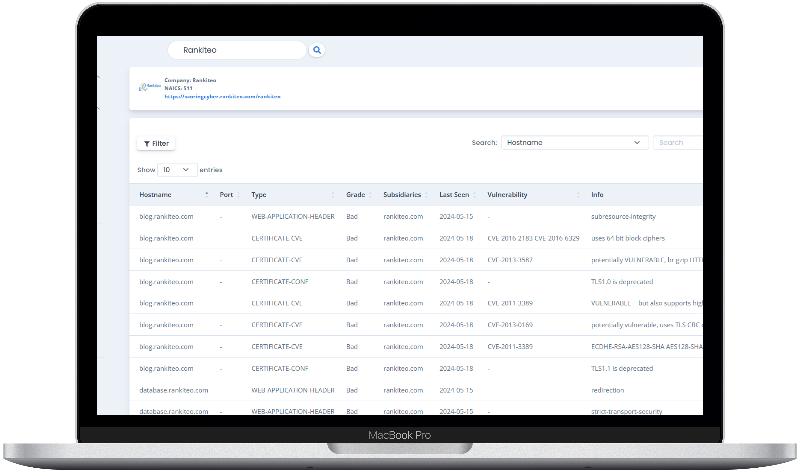
Identify exposed access points, detect misconfigured SSL certificates, and uncover vulnerabilities across the network infrastructure.
Gain visibility into the software components used within an organization to detect vulnerabilities, manage risk, and ensure supply chain security.
Monitor and manage all IT assets and their configurations to ensure accurate, real-time visibility across the company's technology environment.
Leverage real-time insights on active threats, malware campaigns, and emerging vulnerabilities to proactively defend against evolving cyberattacks.








 Rapid
Rapid